
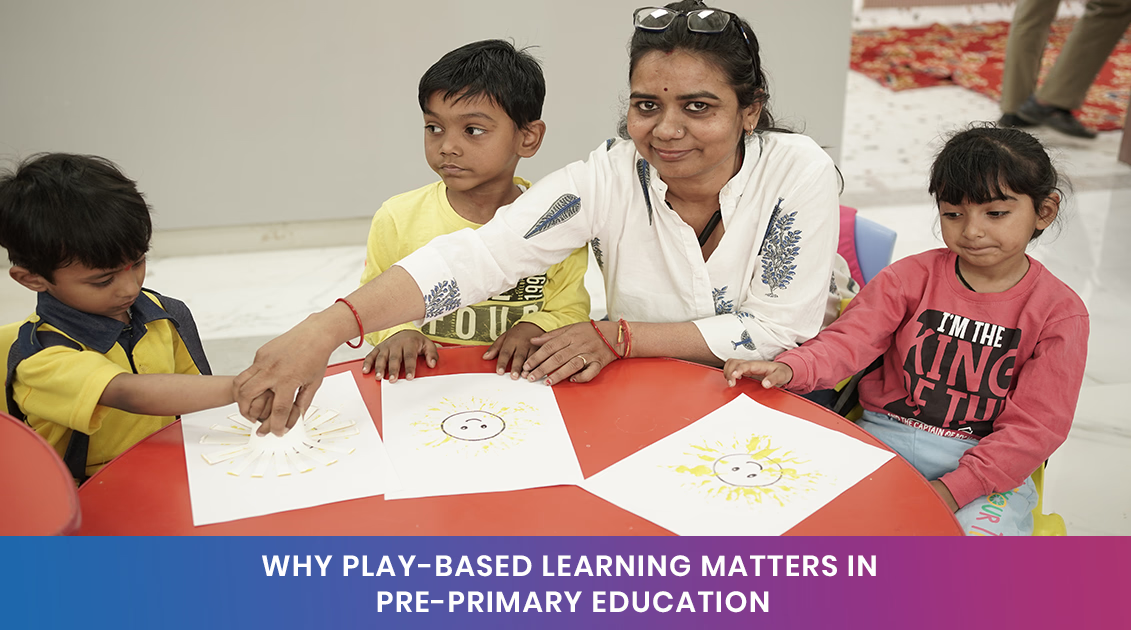
Pre-primary education works best when children are active
participants rather than passive listeners. At this age,
meaningful play is not a break from learning; it is one of the
main ways children learn language, patterns, movement,
cooperation and self-control.
For parents researching this topic, pre-primary program
provides relevant first-party information from the school.
Play Builds Language Naturally
Role play, storytelling, songs and group activities encourage
children to listen, speak and express ideas. This creates a
richer foundation than asking children to repeat isolated
words. Parents searching for the Best pre primary school in
Greater Noida West should look for classrooms where
communication develops through interaction.
For verified school information, parents can review the
pre-primary program
and the
Best Nursery School in Greater Noida West
while comparing options.
Hands-On Activities Strengthen Thinking
Sorting, matching, building, puzzles and simple experiments help children notice patterns and relationships. These experiences introduce early mathematical and scientific thinking without turning learning into formal testing.
Movement Supports Brain and Body Development
Fine motor activities such as drawing, clay work and threading prepare children for writing, while running, balancing and outdoor play develop gross motor coordination. A well-rounded pre-primary day should include both quiet focus and physical movement.
Social Play Teaches Important Life Skills
Children learn to share materials, wait for turns, solve small disagreements and cooperate on group tasks. These everyday interactions help build patience, empathy and independence—skills that support classroom readiness in later grades.
Creative Activities Build Confidence
Beyond classroom learning, students are encouraged to take part in sports, music, dance, drama, public speaking and other co-curricular activities that build confidence, communication and teamwork. In the early years, art, music, dance and speaking opportunities help children become comfortable expressing themselves without fear of making mistakes.
Parents Should Look for Balance
A strong pre-primary program should prepare children for primary school while respecting their developmental stage. The goal is not to rush formal academics but to create curiosity, routines and foundational skills that make later learning easier.
Practical Questions Parents Can Ask Before Shortlisting
When evaluating options around best pre primary school in
Greater Noida West, parents can make school visits and enquiry
calls more useful by asking specific questions.
How are
children supported when they do not understand a concept the
first time?
How often do students use laboratories, libraries,
sports and activity spaces?
What does a normal week look like
beyond textbook lessons?
How does the school communicate
academic progress or behavioural concerns to families?
What
safety procedures apply at arrival, dispersal and during the
school day?
For older students, ask how examination
preparation, subject choices and future planning are handled.
For younger children, ask about settling-in routines,
supervision, play, hygiene and the way teachers communicate
milestones. These questions turn broad claims into information
that parents can compare across schools.
Why Local Fit Matters in Greater Noida West and Noida Extension
A school can be academically strong and still be the wrong practical fit for a family. Daily travel time, transport reliability, school timings, activity schedules and communication routines affect the child’s experience throughout the year. Families in Greater Noida West and Noida Extension should therefore evaluate both educational quality and everyday convenience. A manageable routine can leave students with more time for sleep, homework, reading, sports and family life. Parents should also consider whether the school can support the child across future grade levels, so that a good early decision does not create an avoidable transition later. Looking at the complete academic journey helps families judge continuity as well as immediate admission needs.
Where St. Teresa School Fits Into the Comparison
St. Teresa School, Sector-3, Greater Noida West, is an English-medium co-educational school that focuses on academics, character formation and the holistic development of students. The overall approach is designed to develop confident, compassionate and responsible learners who can handle future academic and life challenges with maturity. Parents can review nursery school page, creative skills, admission details for additional details before making an admission decision.
Conclusion
Parents comparing pre-primary schools in Greater Noida West should ask how much of the day includes guided play, creative expression, movement and interaction. St. Teresa School describes an activity-based early-learning approach that families can explore before applying.
A Parent Checklist for the Early Years
For nursery, playgroup and pre-primary admissions, parents
should observe how adults speak to children, how transitions
are managed and whether activity areas are designed for
age-appropriate movement. A young child may not be able to
explain a school day in detail, so the emotional tone of the
classroom matters. Look for patient teachers, predictable
routines, safe play, clean washrooms, opportunities for
storytelling and conversation, and a balance between guided
activities and free exploration. The goal at this stage is not
to rush children into formal academic pressure; it is to help
them become comfortable, curious and ready to learn.
Parents should also ask how the school communicates milestones
such as language development, social interaction, fine-motor
skills and classroom independence. A good early-years
programme works best when school and home follow consistent
routines. Families considering St. Teresa School can review
the school’s nursery or pre-primary information together with
the admission procedure before a campus visit, then use the
visit to confirm day-to-day routines, safety arrangements and
the kind of learning experiences offered to young children.